
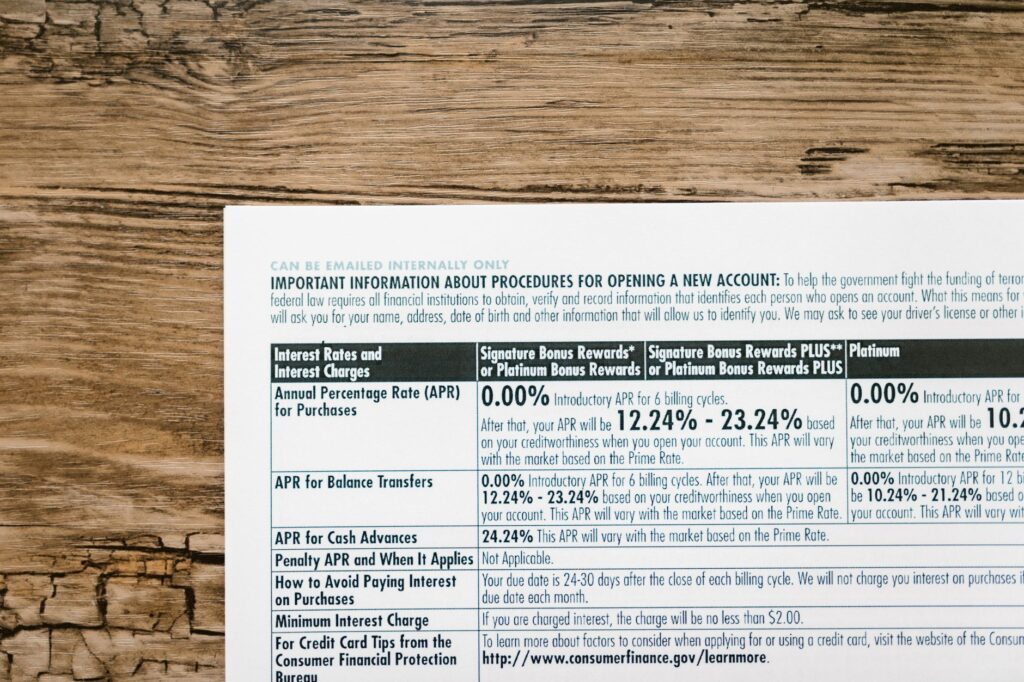
On September 16, the Federal Reserve raised interest rates for the first time in more than three years, a quarter point, to a range of 3.75% to 4%. The headlines that followed warned that credit card rates were about to climb. They did, by a quarter point. If you carry a $6,000 balance, that works out to about $15 a year. Meanwhile, a different part of how credit card APR is set has added roughly $345 a year to that same balance since 2013, and it barely makes the news.
That other part is the margin. Your card’s rate is built from two pieces, and the one that makes the evening news eight times a year is the smaller of the two.
Your card’s rate is a formula with two parts
Almost every credit card in the U.S. carries a variable APR, and “variable” has a precise meaning. The rate equals an index plus a margin. The index is nearly always the prime rate published in The Wall Street Journal, which sits three percentage points above the top of the Fed’s target range. After the September hike it moved from 6.75% to 7.00%, and the Fed’s own H.15 release showed it at 7.00% through November 4.
The margin is the number the issuer adds on top. It isn’t set by any regulator. The issuer chooses it when you open the account, usually based on your credit profile and on what the issuer wants to earn on that card product.
You can see the formula in any cardholder agreement. Capital One’s consumer card agreement for the second quarter of 2026 says it calculates variable rates “by adding a percentage to the Prime Rate published in The Wall Street Journal,” and it lists purchase APRs as prime plus a margin between 19.24% and 22.24%. The agreement also lists the daily periodic rate, starting at 0.07121%. Multiply that by 365 and you get 25.99%, which is the 6.75% prime rate in effect when the agreement was written plus the 19.24% margin. The arithmetic checks out to the hundredth.
The Fed controls the small number
Most explainers, including our own primer on the prime rate, make the same point: when the Fed moves, prime moves by the same amount, and your card follows. That’s true. But it describes only the index, and the index has been the less interesting half of the story for a decade.
You can measure this yourself with the Federal Reserve’s G.19 consumer credit release, which reports the average interest rate on credit card accounts that were actually charged interest. In the fourth quarter of 2013, that rate was 12.89%, while prime was 3.25%. Subtract one from the other and the average margin was about 9.6 points. In the second quarter of 2026, the G.19 rate was 22.15% with prime at 6.75%, a margin of about 15.4 points. The August 2026 preliminary figure, 22.36%, puts it closer to 15.6.
So over roughly 13 years, the margin portion of the average card rate grew by about 5.8 percentage points. The Fed’s September hike moved the index by 0.25. Divide one by the other and the margin’s growth is about 23 times the size of the hike that dominated the headlines.
This isn’t only our arithmetic. The Consumer Financial Protection Bureau ran a similar analysis in early 2024 and found that the average APR margin hit a record 14.3% in 2023, up from 9.6% in 2013, according to American Banker’s coverage of the report. The CFPB estimated the wider margins cost a consumer carrying $5,300 in card debt more than $250 extra that year. The margin has kept creeping up since.
On a $6,000 balance, the margin costs 23 times more than the hike
Put the two pieces side by side on a $6,000 balance carried for a year, ignoring compounding to keep things simple.
The September Fed hike raised the index by 0.25 point. That’s $6,000 times 0.0025, or $15 a year.
The growth in the average margin since 2013, about 5.76 points (15.40 minus 9.64), costs $6,000 times 0.0576, or $345.60 a year.
Now compare the average card to the Capital One card above. Its lowest margin, 19.24%, is 3.84 points above the 15.40-point average. On $6,000 that’s another $230.40 a year, just from which card is in your wallet. The full gap between that card’s margin and the 2013 average works out to about $576 a year. The Fed had nothing to do with the last two.
How credit card APR is set: the margin gets locked in at the door
If margins matter this much, why don’t they change every time the economy shifts? Because the law makes the margin sticky in a way the index is not.
The Credit CARD Act of 2009 and the Federal Reserve’s rules implementing it (proposed in the Federal Register in October 2009 and finalized in early 2010) bar issuers from applying a higher rate to an existing balance except in a few situations: a promotional rate of at least six months ends, the index rises, or you’re more than 60 days late on the minimum payment. Rate increases are also barred during the first year after you open the account. After that, an issuer can raise the rate on new purchases, but only with 45 days’ advance notice.
That has a quiet consequence. The index can push your rate up any time it rises, with no notice beyond your statement. The margin, by contrast, tends to be priced at the door. When issuers decide to earn more, the easiest place to do it is on new accounts, where there’s no existing balance to protect and no change-in-terms notice to send. So the record margins in the G.19 data most likely tell you how cards are priced when they’re opened, more than how existing cardholders were repriced.
There’s also a timing wrinkle in how the index flows through. Capital One’s agreement resets variable rates using the prime rate published on December 25, March 25, June 25, and September 25, with new rates taking effect at the start of the January, April, July, and October billing periods. The Fed’s September 16 hike was caught by the September 25 reading and hit Capital One statements starting in October. Other issuers update monthly, so the same hike reaches different cardholders at different times.
The margin is the number to look up on your own card
Think about what this implies for the debates over rate caps. In January 2026, President Trump called for a one-year 10% cap on credit card interest rates, NPR reported, though nothing took effect. Whatever you think of that idea, notice that the average margin alone, about 15.4 points, already sits well above 10%. A cap at that level wouldn’t trim the Fed’s share of your rate. It would cut into the issuer’s.
For your own card, the takeaway is that the number to look up isn’t the prime rate. It’s your margin. Find your cardholder agreement or the pricing table on your statement and look for the phrase “prime plus.” Subtract 7.00 from your current APR and you have it. If it’s well above the roughly 15-point average, that tells you how you were priced, not how the economy is doing.
This matters most if you carry a balance into the new year. A card’s margin also feeds the interest that drives your minimum payment, so a high-margin card costs you on both ends. The Fed’s next meeting will get the attention. But how credit card APR is set comes down mostly to a number the issuer chose the day you opened the card, and that number has been doing most of the climbing.
Sources
- Federal Reserve Board, G.19 Consumer Credit release (October 7, 2026) and historical terms of credit data: www.federalreserve.gov
- Federal Reserve Board, H.15 Selected Interest Rates (bank prime loan rate, November 2026)
- Federal Register, Truth in Lending proposed rule implementing the Credit CARD Act (October 21, 2009): www.govinfo.gov
- Capital One, Credit Card Agreement for Consumer Cards in Capital One, N.A. (Q2 2026): ecm.capitalone.com
- American Banker, “Credit card issuers’ APR margins hit record 14.3% in 2023, CFPB says” (February 2024): americanbanker.com
- Al Jazeera, coverage of the September 16, 2026 Federal Reserve rate decision
- NPR, “Trump calls for a 10% cap on credit card interest rates” (January 12, 2026)