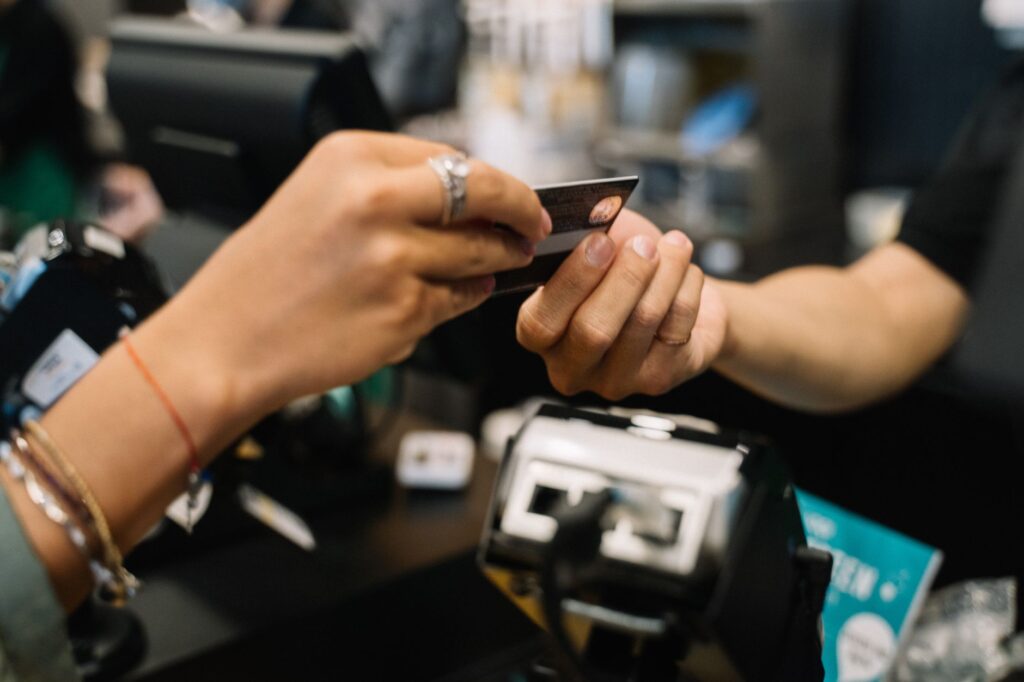
Picture it: Black Friday, November 27, you’ve finally found the TV and the laptop you’ve been tracking for weeks, and your debit card gets declined. You check your banking app in the checkout line. The money is right there. So what happened?
Most likely you ran into your card’s daily limit. Every debit card comes with caps on how much you can spend and how much cash you can pull out in a day, and those caps have nothing to do with your balance. Most people never find out what theirs are until a big purchase bounces off one. With the National Retail Federation reporting that 64% of holiday shoppers plan to do most of their buying over Thanksgiving weekend this year, a lot of people are about to discover their limits at the same time.
Two limits, not one
Your debit card usually has two separate daily caps.
The purchase limit covers what you can spend at stores and online in a day. Wells Fargo, in a 2026 explainer on how these limits work, defines it as the maximum dollar amount of purchases per day from your primary linked account, and it includes any cash back you ask for at the register. It also counts what Wells Fargo calls account funding transactions, such as moving money into a digital wallet or a brokerage account with your card. People tend to forget that last part. If you topped up an app with your debit card in the morning, that amount is already chipping away at your purchase limit by afternoon.
The ATM limit is the most cash you can withdraw in a day. At Wells Fargo, that limit also gets reduced by any fee a non-Wells Fargo ATM operator charges you, so a $3.50 surcharge comes out of your daily allowance too.
The two limits run independently. Hitting your ATM cap won’t stop you from swiping at a store, and vice versa.
What the limits look like at a big bank
Banks don’t all publish these numbers in an easy place, but Chase lists them in its Clear and Simple Guide for Chase Total Checking, effective June 14, 2026. A standard Chase debit card comes with a $5,000 daily purchase limit. For cash, you can take out up to $3,000 a day inside a Chase branch, $1,000 at other Chase ATMs, and $500 at non-Chase ATMs (that last one rises to $1,000 for accounts opened in Connecticut, New Jersey, and New York).
Premium tiers get more room. The Chase Sapphire Banking and Chase Private Client debit cards both carry a $7,500 purchase limit. Chase First Banking, the account for kids, gets a $400 purchase limit and $100 a day at any ATM, which tells you something about who the limits are designed to protect.
Other banks set their own numbers. Wells Fargo says limits vary by card type, account type, and factors such as how long you’ve been a customer, and it notifies you of your limits when your card arrives. If that envelope went in the recycling years ago, your app is the next best place to look.
Why banks set limits at all
The short answer is fraud. If someone gets your card number or watches you type your PIN, the daily limit caps how much they can drain before you notice. Wells Fargo’s head of deposits, Chris Starr, put it this way in the bank’s explainer: limits “help your bank or credit union fight fraud, manage risk, and keep funds secure.”
That protection matters more with debit than with credit. When a thief uses your credit card, the bank’s money is on the line while you dispute it. With a debit card, it’s your checking account balance that disappears, and your rent payment can bounce while you wait for the investigation. Federal rules under Regulation E do limit your losses. According to the Consumer Financial Protection Bureau, if you report a lost or stolen card within two business days of noticing it’s gone, your liability is capped at $50. Wait longer and it can rise to $500, and beyond that if you sit on it for more than 60 days after your statement arrives. A daily limit keeps the damage smaller during that window.
Some people assume the limits are tied to the federal rule that requires banks to report cash transactions of $10,000 or more. They aren’t. Wells Fargo notes that the reporting requirement doesn’t cap ATM withdrawals. The limits are each bank’s own business decision.
Available balance and daily limit are different things
This is where the checkout-line confusion comes from. Your available balance is how much money the bank thinks you can use right now. Wells Fargo describes it as your ending daily balance minus holds, plus deposits credited, minus withdrawals the bank can’t return unpaid. Your daily limit is a separate ceiling layered on top.
A purchase has to clear both. If you have $8,000 available and a $5,000 purchase limit, a $6,000 laptop-and-TV run gets declined. If you have a $5,000 limit and only $1,200 available, the limit doesn’t matter because you’ll run out of money first.
The available balance can also mislead you. It doesn’t always reflect checks you’ve written that haven’t cleared or card transactions that merchants haven’t submitted yet. So a figure that looks generous might already be spoken for.
How to check or raise your limit
Start with your banking app. In the Wells Fargo Mobile app, for example, you select the account, tap the Manage tab, then Manage Limits. Many banks have a similar screen buried in card settings. If yours doesn’t, call the number on the back of your card.
Raising a limit isn’t automatic. Chase says you can contact it to request a different limit, subject to approval, and Wells Fargo notes that changes depend on your available balance and may require extra identity verification. For a one-time purchase, a temporary increase is usually the easier request. Call a day or two before your big shopping trip rather than from the register.
Before you raise it, it’s fair to ask whether you want to. A higher limit is more convenient, and it’s also more room for a thief. For a large purchase, a credit card you pay off in full gives you stronger dispute rights and keeps your checking account untouched while any problem gets sorted out.
When cash is part of the plan
Cash is still a regular part of how Americans pay. Wells Fargo, citing the Federal Reserve’s Diary of Consumer Payment Choice, reports that consumers average seven cash payments a month and that nearly 15% of all payments are made in cash, usually for purchases under $25.
If you need more cash than an ATM will give you, for a used car down payment or a contractor who only takes cash, go to a branch. Chase’s in-branch ATM limit is triple its regular Chase ATM limit, and a teller can tell you what’s possible beyond that. Plan a day ahead, especially in the busy weeks before the holidays, and keep your bigger savings in a separate account so a lost card never puts your whole cushion within a thief’s reach.