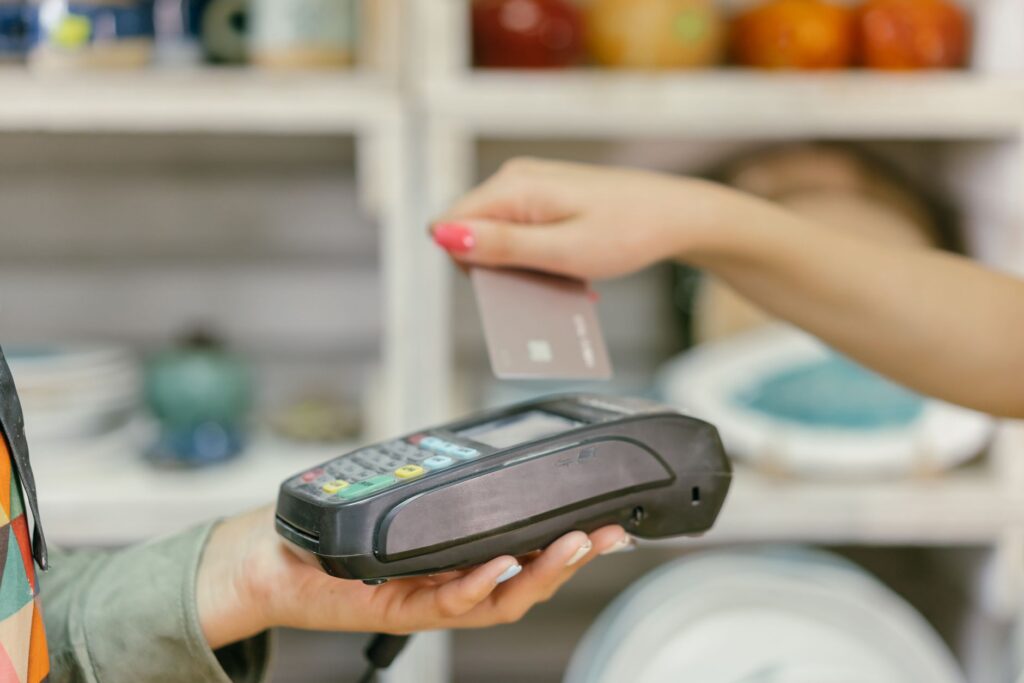
Black Friday checkout lines are about to teach a lot of people a new line on their receipt. You hand over a credit card, and below the tax there’s a 3% “credit card surcharge” or “non-cash adjustment.” It feels like a penalty for using plastic. It’s really closer to a bill for something you were already getting. A credit card surcharge is the store handing you a cost that, in a roundabout way, has been paying for your rewards all along.
To see why, follow the money on a single swipe.
Every credit card swipe carries a fee the merchant never chose
When you pay with a credit card, the merchant doesn’t receive the full price. A slice goes to the card network and the payment processor. The biggest slice, called the interchange fee (the swipe fee), goes to the bank that issued your card. The merchant doesn’t negotiate interchange. The networks publish the fee schedules, and the merchant’s processor rolls everything into one number called the merchant discount rate.
Those slices add up to a lot of money. The Federal Reserve Bank of St. Louis reported in April 2026 that U.S. banks collected nearly $66 billion in interchange fees in 2025, up from $64 billion in 2024 and $52 billion in 2021. Swipe fees made up roughly 11% of banks’ noninterest income in 2025, compared with 9% in 2021. For a bank, your card isn’t a side business.
Your rewards are funded out of that swipe fee
Banks don’t advertise this, but your 2% cash back and your sign-up bonus are paid for largely with interchange revenue. Premium and rewards cards come with higher swipe fees than plain cards, which is exactly how the bank can afford to be generous with you. Merchants know it, too. Objecting to this year’s card network settlement, retailers argued they would still pay too much to accept rewards cards.
For decades, merchants handled that cost by spreading it across every customer through slightly higher shelf prices. So the shopper paying cash was quietly chipping in for your points. A surcharge changes the arrangement. It bills the cost to the person whose card caused it.
The rules that decide how big a surcharge can be
Merchants can’t pick any number they like. Visa caps credit card surcharges at the lower of 3% or the merchant’s actual cost of acceptance, a limit that took effect April 15, 2023 (down from 4%). Mastercard’s cap remains 4%, according to an analysis by the law firm ArentFox Schiff. Either way, the surcharge has to be disclosed at the point of sale, in store and online, before you pay. A store that profits on its surcharge is breaking the card networks’ rules, since the fee can’t exceed what accepting the card actually costs.
Debit and prepaid cards can’t be surcharged at all, even if you choose “credit” on the keypad. That lines up with the economics. Since 2011, the Durbin Amendment has had the Federal Reserve cap debit swipe fees at large banks, so there’s far less fee to pass along. (That cap is now tied up in court, which we explained in our piece on the debit card swipe fee cap ruling.) The same Dodd-Frank law also protects a merchant’s right to offer a discount for paying with cash. That’s why gas stations post a “cash price” and a “card price.” A cash discount and a surcharge can produce the exact same two prices. The label is the difference, and the label decides which rules apply.
States add their own layer. Connecticut, Massachusetts, Maine and Puerto Rico have statutes that prohibit surcharging outright, according to the payment processor Stax. Colorado and Oklahoma cap surcharges at 2%.
The credit card surcharge usually costs more than your rewards earn
Here’s where the mechanism hits your wallet. Say you put $1,500 of holiday shopping on a 1.5% cash back card, all at stores that add a 3% credit card surcharge. The surcharges come to $45 ($1,500 times 0.03). Your rewards come to $22.50 ($1,500 times 0.015). You’re $22.50 behind, and a debit card, which can’t be surcharged, would have cost you nothing. A 2% card doesn’t rescue you either: $30 in rewards against $45 in fees still leaves you $15 down.
The card still wins in two situations. One is when the surcharge is smaller than your rewards rate, which can happen with a 2% fee in Colorado and a 2% card. The other is when you need what a credit card does and debit doesn’t, like purchase protection or disputing a charge without your checking balance tied up while it’s sorted out. Those are good reasons. They just deserve to be a decision rather than a habit.
Shoppers already sense the tradeoff. A PYMNTS Intelligence report found 56% of consumers were very or extremely likely to switch merchants over surcharge fees, and another found 68% check most or all of their receipts because they’re nervous about hidden surcharges, according to PYMNTS’ February 2026 coverage.
The Visa and Mastercard settlement pushes this cost further into the open
On June 9, 2026, U.S. District Judge Brian Cogan in Brooklyn gave preliminary approval to a revised $38 billion settlement between Visa, Mastercard and merchants, Reuters reported. In Visa’s description of the terms, the average effective credit interchange rate drops by 10 basis points (0.1 percentage point) for five years, standard consumer credit rates are capped at 125 basis points, and merchants get more options to surcharge.
The bigger change is structural. Merchants could choose whether to accept cards in three separate categories: commercial, premium consumer, and standard consumer. Reuters said that would effectively end the longstanding “honor all cards” rule. Picture what that means at a register. A store could take your basic card and turn down your premium rewards card. Judge Cogan himself noted that merchants can theoretically reject premium cards but probably won’t. Final approval is still pending, and American Banker reported that analysts don’t expect the deal to be fully finalized until 2029.
Whatever the timeline, the direction doesn’t change. The cost of card rewards is slowly moving off the shelf price and onto the receipt, where you can see it.
What a credit card surcharge is really telling you
Once you see the machinery, the surcharge stops looking arbitrary. It’s the price of your rewards, finally itemized. So when you spot a credit card surcharge, do a quick comparison. If the fee is bigger than what your card earns, pay with debit or cash. If it’s smaller, or you want the card’s protections, go ahead and swipe. If you’re curious about the other places your card’s swipe fees quietly fund your perks, our explainer on how cash back portals make money follows a similar trail.