
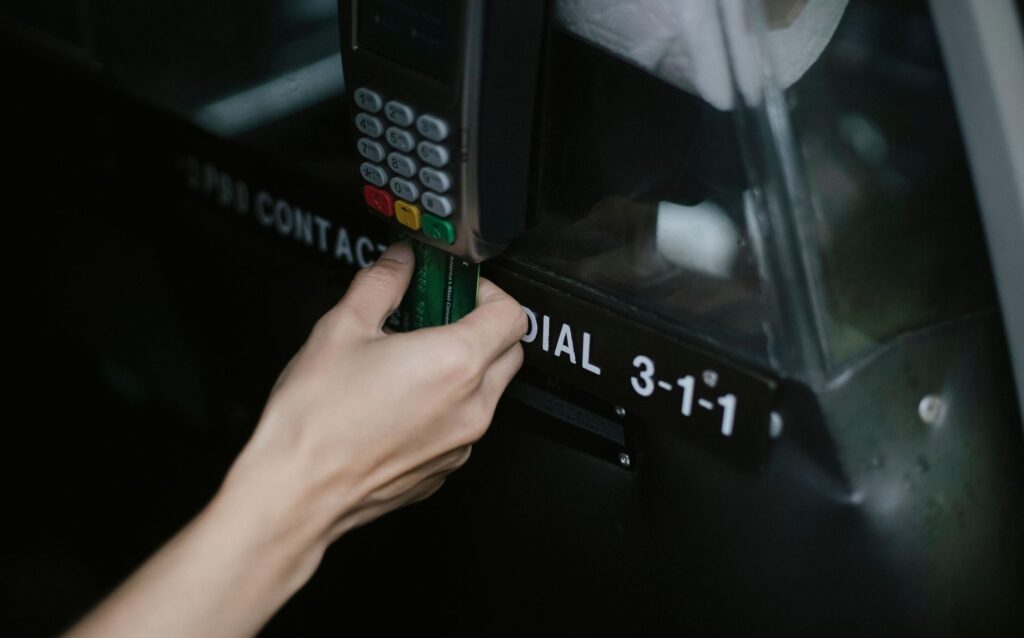
If you’re traveling overseas for the holidays, there’s a good chance a card terminal will ask you a question at some point. You hand over your card at a restaurant in Lisbon or a shop in Toronto, and the screen offers two choices. One is the price in the local currency. The other is the price in U.S. dollars. The dollar option feels safer. You know exactly what you’re paying, and nobody wants to do exchange rate math at the register.
That convenience has a name: dynamic currency conversion, or DCC. And in almost every case, picking it means paying more than you need to.
What dynamic currency conversion is
Normally, when you use a U.S. card abroad, the merchant charges you in its own currency. Your card network, Visa or Mastercard for example, converts that amount into dollars at its wholesale exchange rate, and your bank may or may not add a foreign transaction fee on top.
Dynamic currency conversion moves that conversion step to the merchant’s side. The merchant’s payment processor converts the price into dollars right there at the terminal, using an exchange rate that the processor chooses. You see a clean dollar figure, approve it, and the charge posts to your account in dollars.
The catch is the rate. The processor isn’t using the same wholesale rate your card network would. It builds in a markup, and the dollar price you see already includes it.
DCC isn’t limited to card readers in shops, either. It shows up at foreign ATMs, where the machine offers to “lock in” your withdrawal amount in dollars, and on some foreign websites at checkout.
How big the markup really is
The markup varies a lot depending on the merchant and the processor, which is part of what makes DCC hard to judge in the moment. A study by the German consumer organization Stiftung Warentest, which tested DCC in 11 countries, found that prices rose by 2.6% to 12.0% when DCC was used, as reported by The Motley Fool.
Compare that with the typical foreign transaction fee. Many U.S. credit cards that do charge one set it at around 3% of the purchase. So even if your card charges that fee, DCC can easily cost more. And if your card has no foreign transaction fee at all, every cent of the DCC markup is money you didn’t have to spend.
The Motley Fool gives the example of a European terminal showing a purchase as either 200 euros or $242. The $242 is accurate in the sense that it’s exactly what you’ll pay. What it doesn’t tell you is how far that figure sits above what your own card network would have charged for the same 200 euros.
Why the price looks so trustworthy
The appeal of DCC is mostly psychological. A dollar price feels familiar, and familiar feels fair. You don’t have to wonder what the exchange rate is, and you won’t get a surprise when the charge posts.
But certainty isn’t the same as a good deal. When you pay in the local currency, the final dollar amount depends on your card network’s rate on the day the charge is processed. That rate is usually close to the wholesale market rate. With DCC, you’re trading a small amount of uncertainty for a guaranteed markup.
The European Consumer Organisation, known as BEUC, looked at this trade a few years ago and didn’t mince words. It concluded that DCC leaves consumers financially worse off in practically every single case, and it called for an outright ban.
What European rules now require
Europe didn’t go as far as a ban. Instead, it focused on transparency. Regulation (EU) 2019/518, which amended the EU’s cross-border payments rules, requires DCC providers to disclose their total currency conversion charges as a percentage markup over the latest euro foreign exchange reference rates published by the European Central Bank. That figure has to be displayed clearly at the ATM or point of sale before you pay, and the provider must offer you the choice of paying in the local currency.
The rules also require a European cardholder’s own bank to send an electronic message showing the markup after a card payment or cash withdrawal in a foreign currency.
For American travelers, this is useful mainly inside the EU. If you see a markup percentage on the screen, that’s the regulation at work, and it gives you a quick way to judge the offer. A 5% or 7% markup over the ECB rate is real money on a hotel bill. Outside the EU, you’ll often see no disclosure at all, just two prices and a button.
How to avoid DCC on your next trip
The fix is simple once you know to look for it: always choose the local currency. If a terminal shows two prices, pick the one in euros, pounds, pesos, or whatever the country uses. If a cashier asks whether you’d like to pay in dollars, say no and ask to be charged in the local currency. Bankrate’s advice on this is the same, and it’s blunt: say no to dynamic currency conversion.
At an ATM, decline the conversion offer even if the machine warns that you won’t know the final amount. That warning is accurate. You won’t know the exact dollar figure until it posts. You’ll just probably pay less.
Watch out for terminals where the merchant has already selected the dollar option and hands you the device to sign or tap. If you notice that the screen shows dollars, it’s fair to ask them to cancel and run it again in local currency. It feels awkward for about four seconds.
After a purchase, check your banking app. The Motley Fool notes that pending charges abroad are only an estimate until the transaction settles. If a charge posts in dollars when you didn’t choose that, it’s worth calling your card issuer.
Pair the right choice with the right card
Declining DCC works best when the card in your wallet doesn’t add its own fee. A credit card or debit card with no foreign transaction fee means you get the network’s conversion rate and nothing extra. If you plan to use cash, a checking account that reimburses out-of-network ATM fees can help too.
None of this requires a new account just for one trip. But if you travel abroad even once a year, it’s worth knowing which of your cards charges a foreign transaction fee before you leave. The terms are usually listed in the card’s pricing disclosure or rate table.
The bottom line on “Pay in Dollars?”
Dynamic currency conversion is legal, and the price it shows is real. It’s also almost always more expensive than letting your own card do the conversion. The markup can run anywhere from a couple of percent to double digits, and it often lands on top of fees you may already be paying. The safe default is easy to remember: when you’re abroad, pay like a local, in the local currency.
The Motley Fool’s overview of this costly extra fee when you travel internationally is a good quick read, and the full text of Regulation (EU) 2019/518 explains the European disclosure rules in detail.