In 2022, the biggest U.S. card issuers collected $717 million in cash advance fees on $3.6 billion of cash advances, according to a December 2024 CFPB data spotlight. That’s about $1 in fees for every $19 borrowed, before a cent of interest. If you want to understand how credit card cash advances work, start with an idea that sounds odd at first: a cash advance isn’t really a credit card transaction. It’s a separate loan that happens to share your card number, and it plays by its own rules for pricing, for interest, and for which balance your payments go to first.
That last part is where most explanations stop short, and it’s the part that decides what a cash advance ends up costing you.
A cash advance is priced as a different product
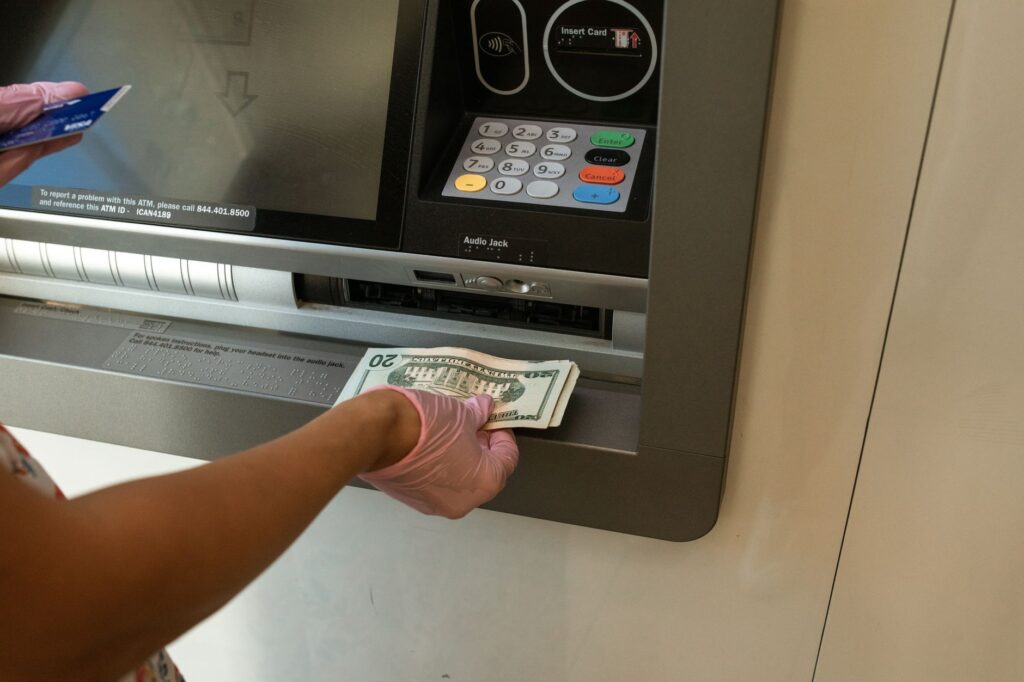
When you buy a sweater with your card, the card network moves money from your issuer to the store, and the store pays a processing fee for the privilege. Your issuer earns twice: from that merchant fee and, if you carry a balance, from interest. When you pull $300 out of an ATM with the same card, nobody on the other end pays a merchant fee. The issuer is simply handing you cash, which makes the transaction look much more like a short, unsecured personal loan than a purchase.
So it gets priced like one. Discover’s published card terms set the cash advance fee at the greater of $10 or 5% of the amount, and the CFPB’s review of seven large issuers’ cardholder agreements found that formula was the most common one. The same review found the cash advance APR was most often 30%. For comparison, the Federal Reserve’s G.19 consumer credit release from November 6, 2026, put the average rate on card accounts that were assessed interest at 22.36% in the third quarter of 2026. A cash advance, in other words, starts about seven or eight percentage points above what revolvers already pay on purchases, and there’s a fee charged before the interest even starts.
Many cards also give cash a separate, smaller limit inside your overall credit line. Your card might have a $6,000 limit with only $1,200 available as cash. That is the bank telling you it treats this as a riskier loan.
There is no grace period, so interest starts on day one
On purchases, most cards give you a grace period: pay the full statement balance by the due date and you owe no interest at all. That grace period is why plenty of people use credit cards for years without paying a dollar of interest.
Cash advances don’t get one. Interest starts accruing the day you take the cash and keeps accruing daily until the advance is paid off. The CFPB worked through an example: take a $400 cash advance and hold it for one month, and you’ll pay a $20 fee plus about $10 in interest. That’s $30 to borrow $400 for 30 days. Spread over a year, that comes to roughly 90%, which puts it closer to payday-loan territory than to what most people think of as card debt.
To redo it with your own numbers, work through it step by step. A 30% APR is 2.5% a month, and 2.5% of $400 is $10. The 5% fee on $400 is $20, which beats the $10 minimum, so the issuer charges $20. Add them and you get $30, which is 7.5% of $400 for one month. Multiply 7.5% by 12 and you land at 90%.
How credit card cash advances work against minimum payments
Most explainers skip this mechanism, and it’s what turns a one-month cost into a six-month one.
Once you have a cash advance on the card, you carry at least two balances at two different interest rates. The CARD Act’s payment rules, written into Regulation Z at section 1026.53, say that any amount you pay above the minimum has to go to the highest-rate balance first. That protects you. But the rule says nothing about the minimum payment itself. The official commentary states plainly that the section does not limit the issuer’s ability to decide how the minimum is allocated. That leaves the issuer free to put your minimum toward the cheapest balance, and that’s the case worth planning around.
Picture what that means. Say you owe $1,500 on purchases at about 22% and you take a $400 cash advance at 30%. If you pay only the minimum, that money can go entirely to the cheaper purchase balance while the cash advance sits untouched, growing at roughly 2.5% a month. After six months of faithful minimum payments, that $400 has become about $464, and you still owe all of it.
Now pay $100 above the minimum each month. The rule sends that $100 straight to the 30% balance. The advance drops to $310 after the first month, about $218 after the second, about $123 after the third, about $26 after the fourth, and it’s gone in the fifth. Total interest on the advance comes to about $27. Same card, same advance. The minimum-only path costs about $64 in interest over six months and leaves the balance in place, and the extra $100 a month clears the debt in five. The whole difference comes from where the payment lands.
Plenty of cash advances don’t involve cash
If you never visit an ATM with your credit card, you might assume none of this applies to you. Issuers draw the line more broadly than that. Capital One’s explainer lists wire transfers, money orders, gambling, and sending money through peer-to-peer apps with a credit card as things that may be treated as cash advances, along with the blank convenience checks issuers mail out.
How does the issuer know? Largely through the merchant category codes the card networks assign, which flag some businesses as cash-like. The CFPB’s gambling research shows how much this matters. Chase, Discover, and American Express explicitly list online gambling as a cash advance in their agreements, and Citi and Capital One classify legal wagers that way too. After Kansas launched legal sports betting in September 2022, roughly 8,000 more card accounts incurred a cash advance fee that month than the month before. In Ohio, cash advance fee volume jumped by more than $1 million between December 2022 and January 2023, versus about $9,000 over the same two months a year earlier. The CFPB was careful to call this a correlation, but the timing is hard to miss.
It’s worth knowing heading into the holidays. Thanksgiving week brings a full slate of NFL games, and it’s also when families settle up for trips and dinners over payment apps. Each of those can turn a “card purchase” into a $10 minimum fee plus 30% interest from the first day.
How to think about a cash advance before you take one
Put the pieces together and a cash advance looks less like a feature of your credit card and more like a second loan with three special terms: an upfront fee of about 5%, an interest rate near 30% that starts immediately, and a payment order that can leave it untouched if you only pay the minimum.
None of that makes a cash advance unthinkable. In a true emergency, $30 to borrow $400 for a month can beat a bounced rent payment. But if you take one, pay well over the minimum so the allocation rule works for you, and pay it off first. If you want the background on why card rates sit where they do, we’ve explained how a credit card APR is set and how minimum payments are calculated. Once you see how credit card cash advances work, the pricing stops looking like a penalty. It’s what an unsecured cash loan costs, delivered through a card that looks like it works the same way every time.