
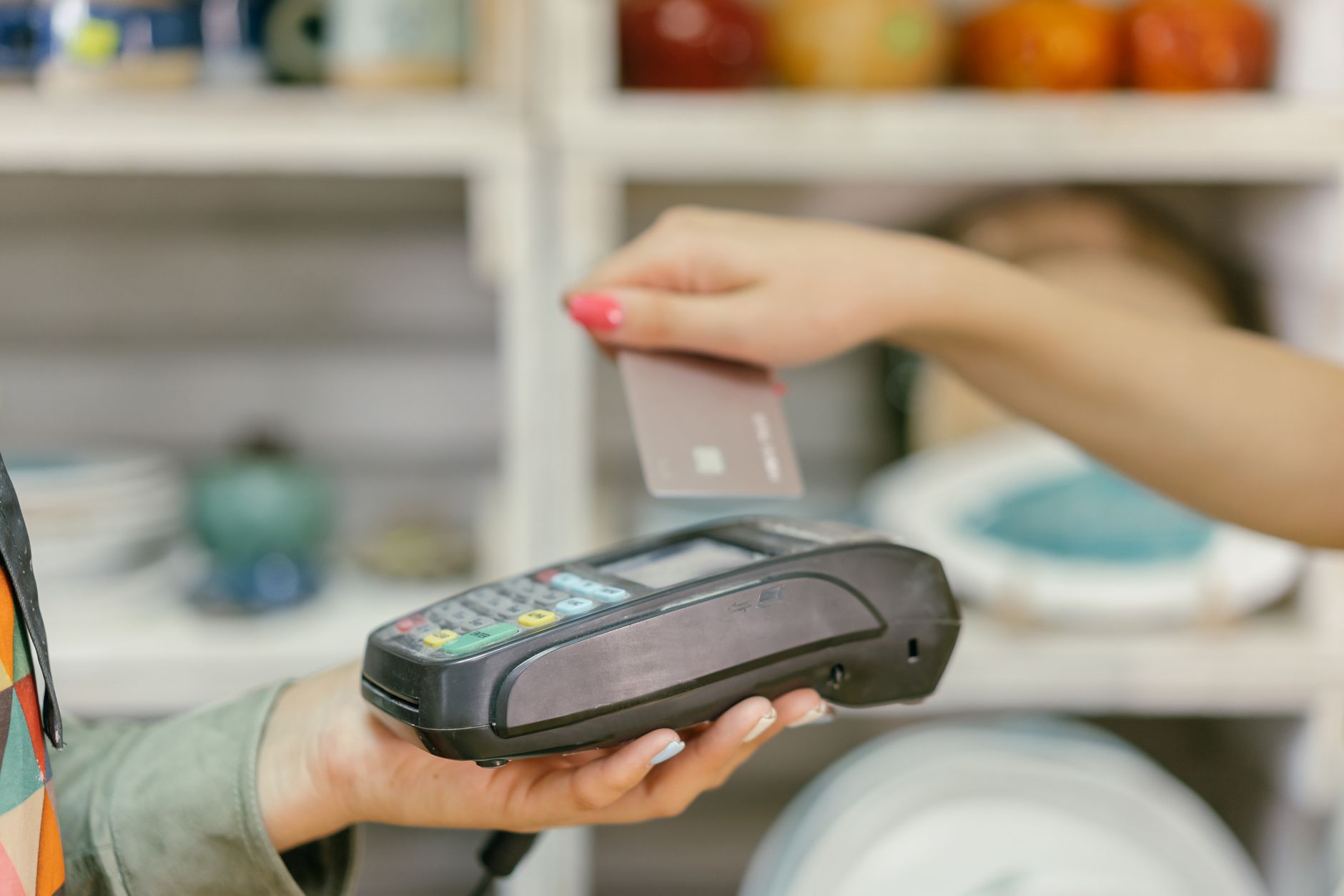
Every time somebody swipes a credit card, the store pays a fee of roughly 1.9% of the purchase to the bank that issued the card. Most of that money funds the cardholder’s rewards. Nobody at the register mentions it, the receipt does not itemize it, and the shopper paying cash behind you in line has no idea she just helped pay for someone else’s airline miles. She did, though. A working paper published through the National Bureau of Economic Research in July 2026 put the annual size of that transfer at about $30 billion.
Interchange fees are usually explained as a merchant problem. They are not. They are a consumer cost that arrives disguised as the price on the shelf, and understanding the mechanism changes how you read the whole rewards industry.
Interchange is a payment between two banks, and you are not a party to it
When you buy a $100 pair of shoes with a credit card, four institutions get involved. Your bank, the issuer, is the one that gave you the card. The store’s bank, the acquirer, is the one that deposits its sales. Visa or Mastercard sits in the middle running the network, and a processor handles the technical plumbing.
The store does not receive $100. It receives something closer to $97.60, because the acquirer withholds a bundle of fees before depositing. The largest slice of that bundle is interchange, which the acquirer pays across to your issuing bank. The card network sets the interchange rate but does not keep it. It collects a separate, smaller network assessment. So the money flows from the store, through the acquirer, to the bank that issued your card, and the bank uses a large share of it to pay for the cash back or points that made you pull out that card instead of a different one.
Rates are not uniform. A rewards-heavy premium card carries a higher interchange rate than a plain no-frills card, which is exactly why your card issuer keeps offering to upgrade you. Debit is different again. Under the Federal Reserve’s Regulation II, banks with more than $10 billion in assets cannot collect more than $0.21 plus 0.05% of the transaction, plus a penny for fraud prevention. Smaller banks are exempt from that cap, and their average debit interchange in 2023 ran about $0.62 per transaction on dual-message networks, roughly triple the regulated rate.
The store pays the fee, and then the price tag passes it back to you
Retailers almost never charge different prices for cash and card. A few gas stations do, and a growing number of small merchants add a surcharge, but the overwhelming default in American retail is one price for everyone. That single price has to cover the average cost of accepting payment across all customers.
The consequence is arithmetic. If a store’s blended payment cost is 1.9% of sales, that 1.9% is baked into every price tag, including the ones paid in cash. The cash customer funds the same pool as the credit customer and collects none of the rewards. The rewards program is a rebate available only to people who use the instrument that triggers the fee.
The direction of the transfer is the part nobody explains
Mark Egan, Gregor Matvos, Amit Seru, Lulu Wang, and Vincent Yao measured this using merchant-level data from Fiserv, one of the largest US merchant acquirers. Their 2022 cross-section covers roughly one million merchants and about one fifth of all US card payments, and a second dataset captures cash transactions alongside card payments.
Their estimate: interchange fees move about $30 billion a year from cash and debit users to credit card users. Cash users lose about 96 basis points of purchasing power. Regulated debit users lose about 47 basis points. Basic credit cardholders gain about 48 basis points, and premium cardholders gain about 59.
Work that through with a household budget. Say you spend $30,000 a year at merchants that accept cards. If you pay in cash, the interchange system costs you about $288 annually in prices you never see broken out. If you run the same $30,000 through a premium rewards card, you come out about $177 ahead. The gap between those two households is roughly $465 a year on identical purchases, decided entirely by which piece of plastic came out of the wallet.
Because credit card use rises with income, the aggregate flows uphill. The researchers estimate about $9.2 billion moves annually from households earning under $150,000 to households earning more. The Federal Reserve’s 2025 Diary of Consumer Payment Choice shows the mechanism plainly: households earning under $25,000 use cash for 24% of their payments, while households earning over $150,000 use cash for only 9%.
The transfer is smaller than it could be, for a slightly depressing reason: cash users and premium cardholders do not shop in the same places very often, so there is less overlap available to cross-subsidize. Where they do stand in the same checkout lines, mainly large grocery chains and gas stations, interchange rates happen to be lower thanks to sector discounts and volume deals negotiated by chains with real bargaining power. The researchers estimate those two effects shrink the transfer by about a quarter.
The Durbin Amendment tried to fix this and made it worse for debit users
If a system quietly moves money from lower income households to higher income ones, the obvious response is to regulate the fee down. Congress did precisely that in 2010, capping debit interchange for large issuers on the theory that lower fees would flow through to lower prices. Prices did fall somewhat. The problem is who collected the savings.
The NBER researchers found the cap primarily benefited credit card users through those lower retail prices, while regulated debit users lost roughly $9.6 billion in rewards and free checking benefits that banks had been funding with debit interchange. Debit rewards programs largely vanished after 2010, and that is not a coincidence. The net effect was a transfer from middle income households to higher income ones, which inverts the stated purpose of the rule. If you have ever wondered why your checking account picked up a monthly fee somewhere around 2011, this is a substantial part of the answer.
The second big shift has been the rise of premium cards, which grew from 15% of credit card volume in 2006 to 60% by 2022. Premium cardholders gained about $7.9 billion. Debit users, not cash users, absorbed the largest dollar losses, because debit users shop most often at the same stores as premium cardholders.
The $38 billion settlement trims interchange fees by a tenth of a point
In June 2026, US District Judge Brian Cogan granted preliminary approval to a revised $38 billion settlement between Visa, Mastercard, and more than 12 million merchants, calling it fair, reasonable, and adequate. It came nearly two years after a different judge rejected an earlier $30 billion version as too small.
The terms cut interchange by 0.1 percentage points for five years, cap standard consumer rates at 1.25%, and give merchants more room to surcharge credit transactions and to decline certain card categories. The National Retail Federation opposed the deal and plans further challenges. The Merchants Payments Coalition called the reduction miniscule and noted that the networks can raise rates freely once the temporary cuts expire.
A tenth of a point off a 1.9% average fee is a reduction of about 5%. On the $100 shoes, the store keeps an extra 10 cents. Whether any of that reaches a price tag is a separate question, and the honest answer is that it probably will not be visible.
What this means for the card in your wallet
The practical reading is not “cancel your rewards card.” If the system charges you the fee regardless, opting out of the rebate makes you poorer, not more principled. Somebody who spends $30,000 a year and pays cash is funding the pool and collecting nothing from it.
The reading is that credit card rewards are not free money from a generous bank. They are a rebate on a fee already embedded in the prices you pay, and it is only a good deal as long as you pay the statement in full. Carry a balance at 20% and the interest swallows the rebate several times over. It is also worth noticing when a merchant offers a cash discount or adds a card surcharge, because that merchant is doing the unusual thing: showing you a cost the system normally hides.
Interchange fees sit underneath every card transaction you make, charged to everyone through prices and refunded only to the people holding the right card. Knowing that will not lower your grocery bill, but it does explain why your bank keeps mailing you upgrade offers for a card you did not ask about. Related mechanics worth understanding are why ACH transfers take days to settle and how authorization holds tie up money before a purchase clears.
[…] is a pricing layer under all of this. Part of the interchange fee a merchant pays on every swipe funds the dispute and reimbursement machinery, and interchange on […]